On Inherited Space
Spaces are conceived under particular political and social conditions, inhabited through others, and passed into contexts their designers could not have imagined. What follows is a reading of one address in Berlin — its successive occupations, the ideologies embedded in its construction, and two recent renovations — as a way of thinking about how built space carries, and is transformed by, the conditions of its use.
— I
Leipziger Straße before 1969: commerce, destruction, vacancy
Leipziger Straße was, by the late nineteenth century, one of the commercially significant streets in Berlin. During the Gründerzeit, the industrialisation period following German unification in 1871, it developed as a retail corridor connecting the government quarter of the Wilhelmstraße westward through the city centre. The Wertheim department store opened here in 1897, expanded across an entire city block to designs by Alfred Messel, and became one of the largest department stores in Europe. The store, and the street's commercial life more broadly, was owned and operated substantially by Berlin's Jewish business community. Under the Nazi policy of Aryanisation, the Wertheim family was compelled to cede control of the business in 1937.
The Allied bombing campaigns of 1943–1945 destroyed much of central Berlin. Leipziger Straße, situated adjacent to the Reich Chancellery and other government buildings on the Wilhelmstraße, was among the most heavily damaged areas. By 1945, the street was largely rubble. The Wertheim building, already stripped of its owners, was bombed to ruins. What had been one of Berlin's primary commercial corridors became a prolonged vacancy.
After 1945, Leipziger Straße fell within the Soviet occupation zone and subsequently within the German Democratic Republic. Rubble was cleared incrementally through the 1950s and early 1960s, but reconstruction was slow. The street sat largely undeveloped for more than two decades. It was not until the late 1960s, with the Berlin Wall now dividing the city, that Leipziger Straße became the site of a deliberate urban policy decision.
In 1969, the remaining damaged structures were demolished. The commission for reconstruction fell to Joachim Näther, the capital's chief architect, and Werner Strassenmeier. Their programme called for a mixed-use residential ensemble stretching between Spittelmarkt and Charlottenstraße: 2,000 apartments in towers of eleven to twenty-five storeys, with commercial and cultural facilities integrated into the base of each building. The model was the socialist Wohnkomplex, in which housing function and civic function were organised as a continuous system rather than separated.
The construction method was the Wohnungsbauserie 70, or WBS 70: a prefabricated large-panel system developed by the German Academy of Architecture and the Technical University of Dresden. Concrete panels were cast in factories and assembled on site. Since the exterior walls carried the structural load, interior partitions were non-structural, a feature that would prove significant in later decades. The standard unit was a three-room apartment of 61 square metres. Across the DDR, the WBS 70 would account for more than 40 percent of all prefabricated housing built through 1990. By 1982, after thirteen years of construction, the Komplex Leipziger Straße was complete.

— II
Residency under the DDR, 1982–1989
Under the DDR, housing was allocated rather than purchased. An apartment on Leipziger Straße was a designation by the state: not a commodity, but an assignment that conferred status while remaining contingent on the state's continued approval. Each unit had features the Altbau stock of Prenzlauer Berg or Mitte could not offer: private bathroom, hot water, district heating. Rent for a three-room flat ran to approximately 109 East German Marks per month, around ten percent of the average worker's wage. The state absorbed the cost of construction; the cost of habitation was kept low. The economic relationship between dwelling and income was structurally different from what market housing produces.
The complex drew two residential populations with different access routes. DDR citizens applied through the allocation system, waited years, and understood an assignment on Leipziger Straße as a mark of professional or social standing. Western diplomats and accredited journalists rented units because the complex's proximity to the DDR's governmental and press infrastructure made it operationally convenient. Both populations shared the condition of surveillance. The Ministry for State Security (Stasi) maintained files on residents with western contacts. An apartment on Leipziger Straße was, functionally, a position in the state's information architecture.
The allocation system, called Wohnraumlenkung ("housing steering"), was administered by local council departments that maintained waiting lists and allocated units according to three criteria: social urgency (large families, single mothers, those in overcrowded conditions); economic necessity (specialists and shift-workers whose employer could petition on their behalf); and merit in "socialist construction," which in practice tracked political reliability. The role of the Betrieb (the workplace) was structural: an employer in a priority industry could formally intervene in the queue, and trade union leadership participated in allocation decisions as a matter of procedure. Workers could alternatively join a housing cooperative (Arbeiterwohnungsbaugenossenschaft), contributing money and unpaid construction hours in exchange for a shortened wait. For those without institutional leverage, the wait extended to four, five, or six years. By the end of 1989, over 770,000 housing applications were registered across the DDR; roughly half were from people still living in someone else's household. The standard three-room allocation of 61 square metres at 109 Marks per month represented a ratio of space to income that market conditions would, within a decade, render structurally impossible.
On Leipziger Straße, the allocation patterns reflected the building's dual function. Some units, particularly the larger flats on the northern side east of Jerusalemer Straße, were distributed to families with multiple children under the social priority criterion. Others were routed through the diplomatic system, occupied by western staff who would not have appeared on any ordinary waiting list. The building contained both allocation logics simultaneously, with no visible distinction between them. A resident who had waited seven years through housing commissions and petition letters to the district SED leadership could be living next to someone placed by diplomatic accreditation within weeks.
The Wall was close. The Axel Springer building, the West German press company's headquarters deliberately sited at the border's western edge, was visible from the upper floors of the complex. Some analysts have read the Plattenbau ensemble as a counter-statement to this: a demonstration of socialist construction visible to the West. The DDR's decision to issue a postage stamp featuring the complex in 1979 supports this reading, though the evidence for deliberate propagandistic intent is ambiguous. Joachim Näther, the chief architect, disputed the interpretation. What is clear is that the state regarded the complex as a civic achievement worthy of public representation.
At street level, the integrated commercial programme operated largely as planned. The Ladenstraße, the arcade running along the base of the towers, provided groceries, services, and restaurants, including an Exquisit fashion store and a Delikat delicatessen at the Spittelmarkt end, both representing the higher end of DDR retail. Photographs from this period show ordinary use: people moving through, stopping, waiting. Whether this constituted the socialist ideal of collective habitation or simply the routine of people using housing they had been assigned is a distinction the record does not resolve.


Hans-Dieter Schütt, a journalist with the East German youth paper Junge Welt who lived in the complex and described himself as "honeckerhörig bis zuletzt" (loyal to Honecker until the end), called the street a steinerne Verzweiflungsgegend, a stony landscape of despair. He recalled one episode: a resident climbed to the roof with a home-made flying device and attempted to cross the Wall to West Berlin. He crashed onto a school roof still in the East. The Volkspolizei arrived with dogs. Schütt's son asked his mother whether she would let the man in if he knocked on their door. She said yes, then added: but don't tell your father. His father was a party member. The account illustrates the kind of divided inhabitation the building produced: loyalty and dissent occupying the same flat, the same corridor, the same address.
— III
After reunification: privatisation, renovation, and the housing market
The fall of the Berlin Wall on November 9, 1989 did not alter the physical structure of the Komplex Leipziger Straße. The prefabricated panels remained in place. What changed were the conditions of occupation: the meaning of the address, the legal status of the tenancies, and the framework within which decisions about the buildings would be made. In the winter of 1989 into 1990, over 130 buildings were occupied by squatters across Mitte, Prenzlauer Berg, and Friedrichshain, an assertion of spatial claims the collapsing DDR state was no longer in a position to contest. The Komplex Leipziger Straße was not squatted; it was inhabited and maintained. But the dissolution of the system that had assigned its flats reached it regardless. Western diplomatic staff and journalists left. The Stasi files that had tracked residents were now being requested by those residents themselves, through the Gauck Authority.
Reunification in October 1990 extended the West German legal and property framework eastward. For the Komplex Leipziger Straße, this initiated privatisation: individual units sold to private buyers, tenancies renegotiated under the new legal regime. Renovation began from the mid-1990s onward. Several northern-side buildings received new facades, contemporary thermal cladding applied over the original WBS 70 concrete. The renovations improved energy performance and concealed the material evidence of the construction system. Other parts of the complex retained their original surface. Each decision about what to resurface constitutes an implicit position on which history to make visible.
The apartments remained desirable after reunification, though for different reasons. Tall residential buildings are rare this close to Berlin's centre. The complex's location, adjacent to the federal government quarter and within walking distance of the Gendarmenmarkt and Unter den Linden, attracted a different class of tenant and buyer. What had been a state prestige address, allocated on criteria of professional standing and political reliability, became a market prestige address valued by location and floor area. By the 2010s, the complex was part of Berlin's housing affordability crisis, with long-term tenants facing pressures the DDR allocation system had structurally excluded. The building's second life as a commodity followed, with different social consequences, the logic of its first life as a state resource.
Between these two regimes there was a shorter, less documented period. In the years immediately following reunification, the buildings on Leipziger Straße existed in a condition of administrative suspension. Tenancies were valid under old law or new law; which applied was contested. The surveillance apparatus had dissolved. The lobbies and stairwells were no longer monitored. Rooftops that had been controlled-access were now accessible.
At the Potsdamer Platz end of the same street, at Leipziger Straße 126–128, the vault of the former Wertheim department store was discovered in 1991 by the techno promoter Dimitri Hegemann, who found it through a grate in the pavement during a traffic jam. He opened Tresor there on 13 March 1991: a club in the vault of the bombed-out Wertheim building, with concrete walls, iron safe-deposit boxes still fixed to the walls, and over five hundred people on the opening night. The spatial logic of what followed was direct. From the Wertheim vault at the western end of Leipziger Straße, you could walk a few hundred metres east past the towers where Stasi resident files had recently been maintained. The buildings were accessible in ways they had not been before. A contractor who worked on the complex during this period has described raving near the Gendarmenmarkt, moving to the towers afterward, finding access, climbing to the roof, and watching the sun rise over a city in the middle of being remade. For several years, the buildings offered access their design had never intended and their management had previously controlled. They stood between two systems of control, briefly outside both.

— IV
Two renovations: the space as inherited condition
A renovation negotiates with the existing conditions of a space. The structural walls, window positions, and ceiling heights of the WBS 70 system are fixed; interior partitions are not. What changes and what cannot change determines what the space can become.
Every apartment in the Komplex Leipziger Straße has been occupied differently: differently assigned, differently modified over time. The WBS 70 frame has held more configurations of domestic life than its designers planned for. What follows are two of them.
Both should be understood as responses to inherited conditions rather than blank-slate projects. The flats arrived layered: wallpaper over wallpaper, successive floors over earlier ones, drop ceilings installed over original volumes. Each layer is a record of previous use. The WBS 70 system gave the units the same structural bones; the divergence is everything that accumulated afterward. Both projects took the existing spatial and material conditions as the primary reference, rather than erasing them in favour of a predetermined outcome.
— Floor plan
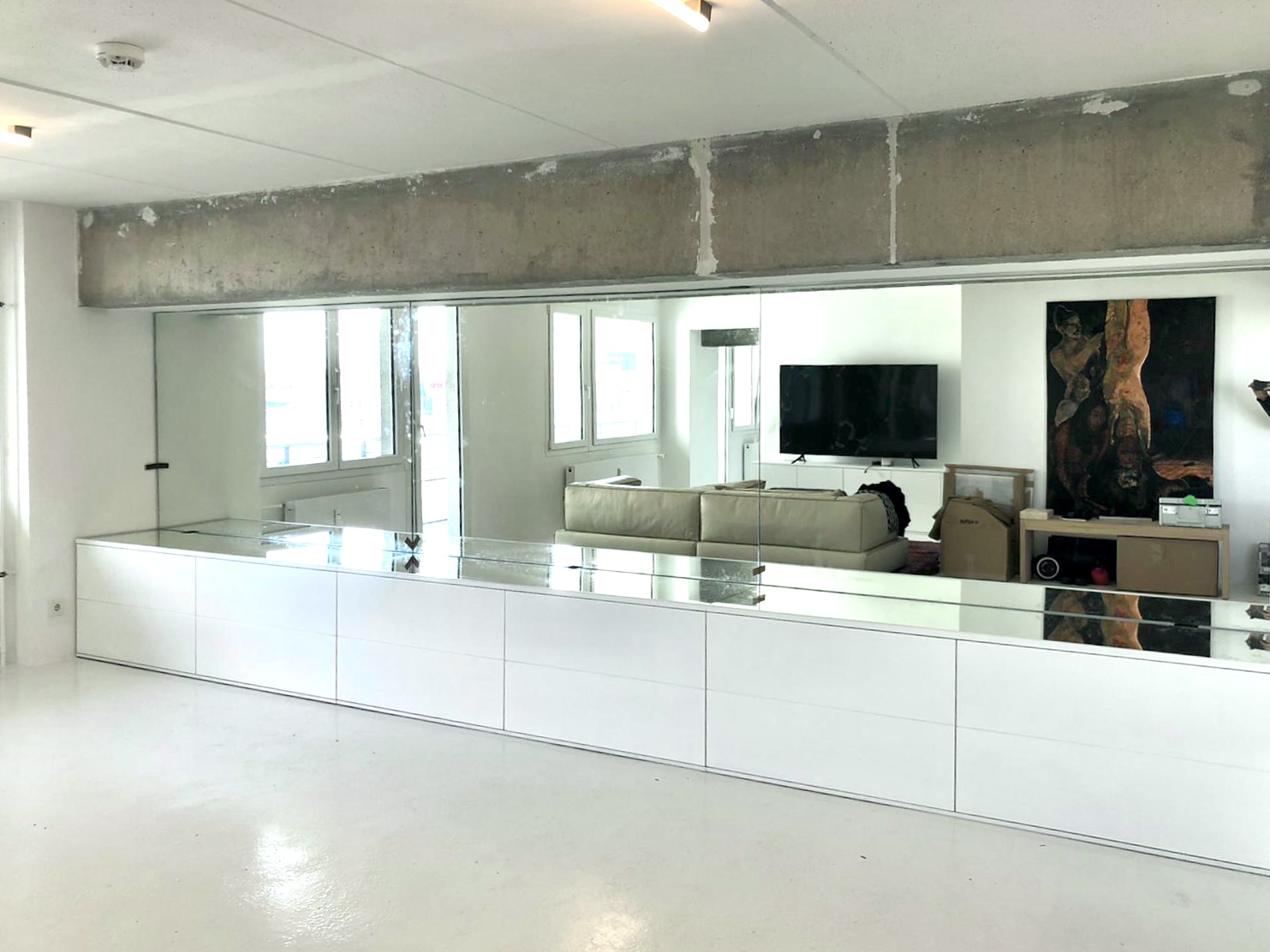
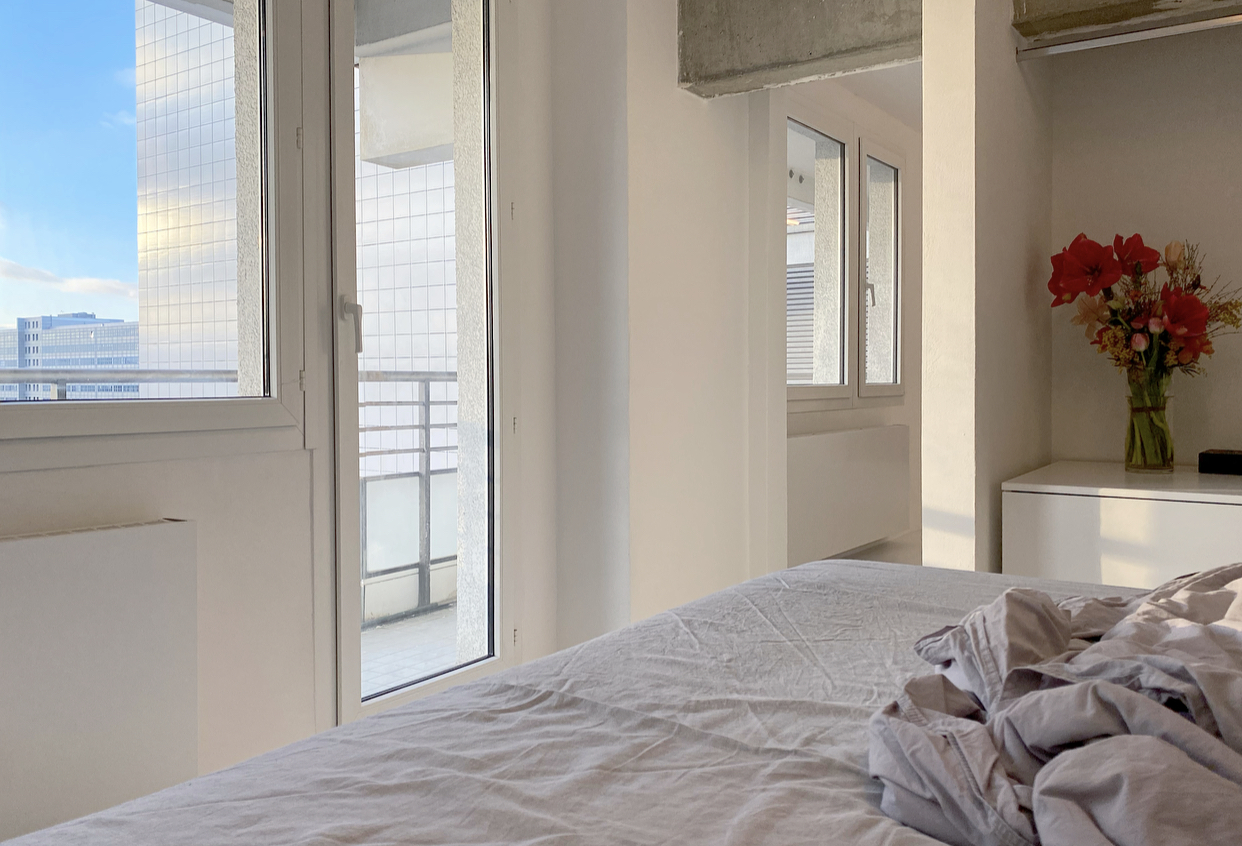
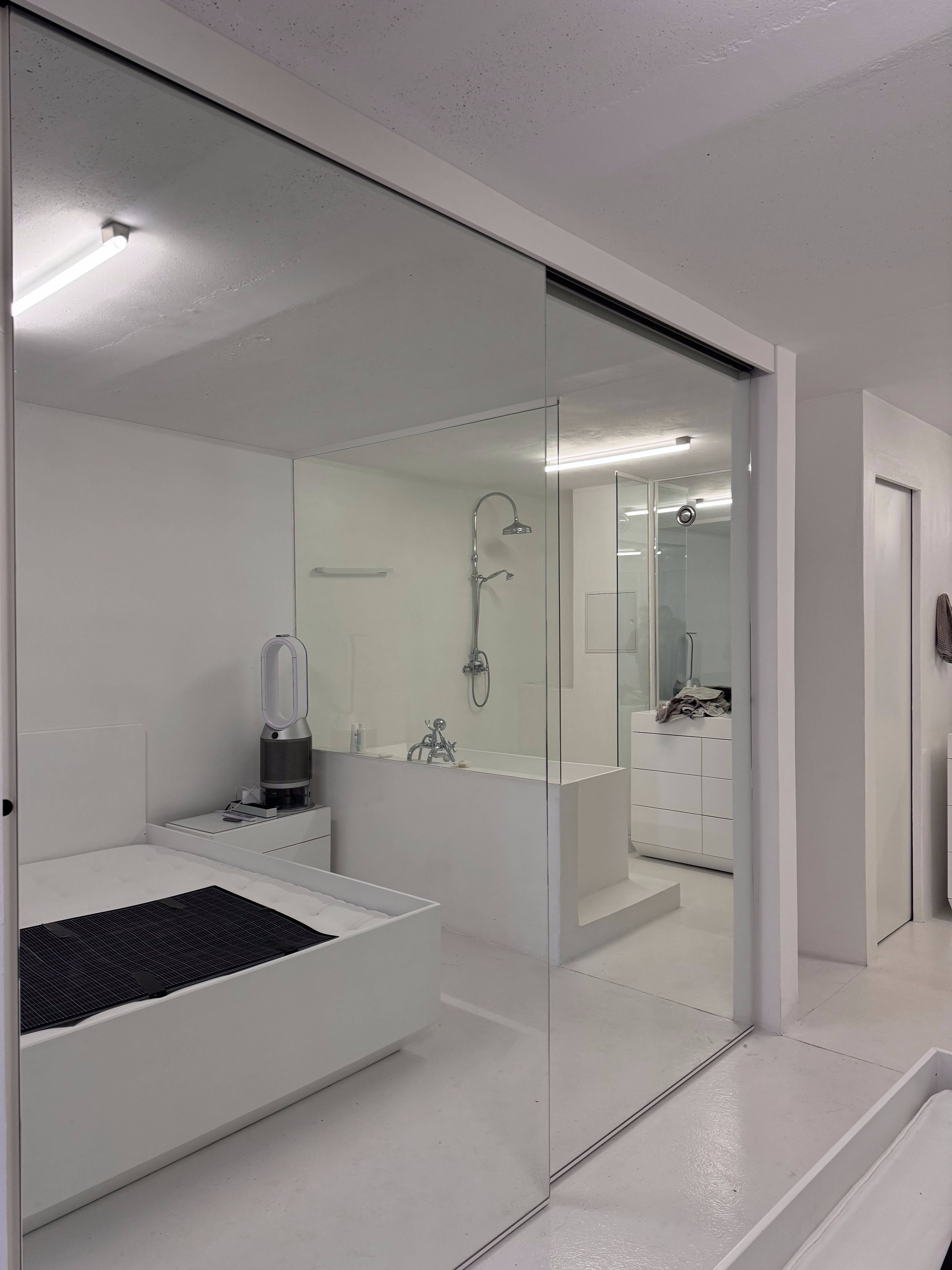
In the spring of 2020, Open Forum Living 44 was stripped back. Decades of accumulated interior modifications were removed: successive wallpapers, layered flooring, drop ceilings. The flat's structure was the WBS 70 system. The partition walls, none of them structural, came out entirely, opening the floor plate into a single volume of 100 square metres.
The organising idea was the cocoon: not as retreat but as a particular spatial mode. During a period when public space had become restricted and the interior took on functions it rarely holds for extended periods, the flat was conceived as a contained environment with its own internal logic. The COVID period made explicit a set of questions about what domestic space is for that most renovations do not need to answer directly.
Everything is white. The choice is not decorative neutrality but a decision about surface behaviour: white receives the north light in the morning differently from the southwest afternoon, changes in quality throughout the day without asserting its own character. The spatial and chromatic consistency is the point. The flat proposes a particular relationship to interiority, one relevant to a period in which the interior was, for many people, the primary available environment.
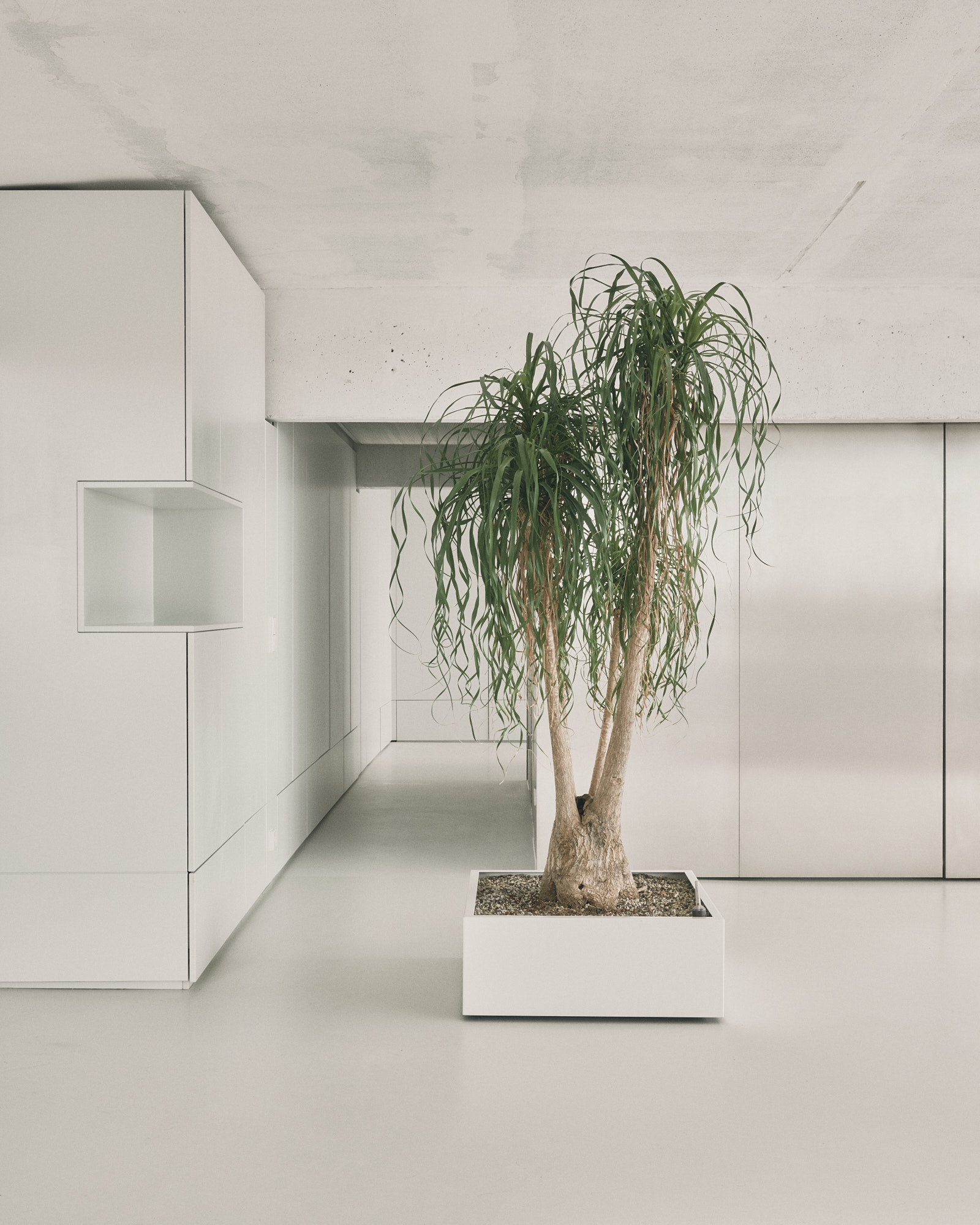
Open Forum Living 48 is itself the product of an earlier intervention. In 1999–2000, two separate units (a four-room flat of 100 square metres and a two-room flat of 50 square metres) were merged into a single 148-square-metre apartment on the 20th floor of Leipziger Straße 48. The resulting flat has two living rooms of approximately 50 square metres each, floor-to-ceiling windows on both the western and eastern faces of the building, a 17-metre balcony running west toward Potsdamer Platz and the Gendarmenmarkt, and a smaller balcony on the east with views toward the Berliner Schloss and the Fernsehturm.
What was found in 2023 was not a flat in its original WBS 70 condition but a space that had already been opened and lived inside under two decades of someone else's decisions. The question was how to strip it back: to identify what the 1999 renovation had covered and what the building's structure was doing beneath it.
The answer was concrete. The WBS 70 load-bearing exterior panels, structural columns, and soffits are present throughout Open Forum Living 48 and in this renovation were left entirely exposed. No plaster, no cladding. The aggregate surface, cast in a factory in the 1970s, is now bare inside the flat on the 20th floor. The building's industrial origin is the interior's primary material.
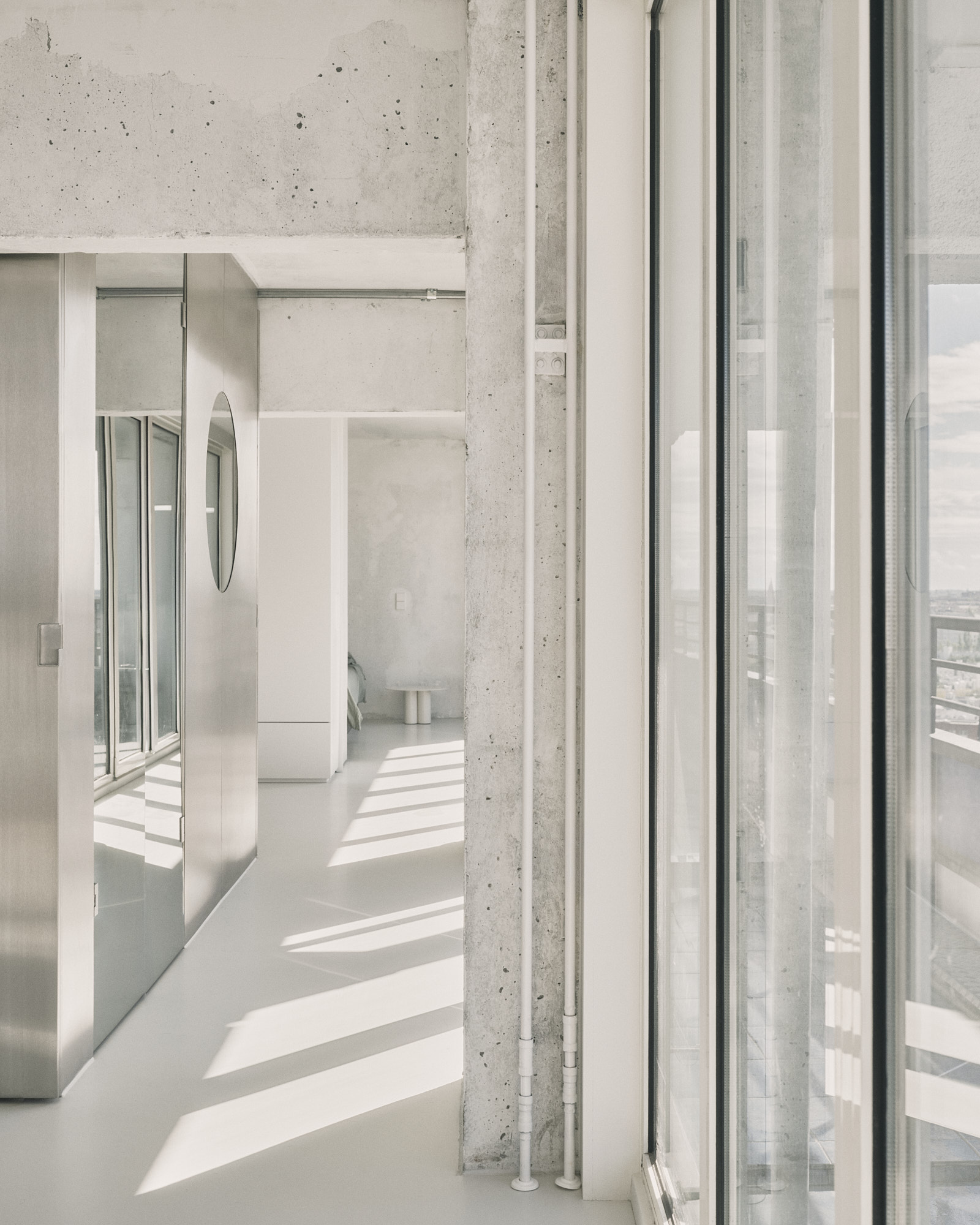
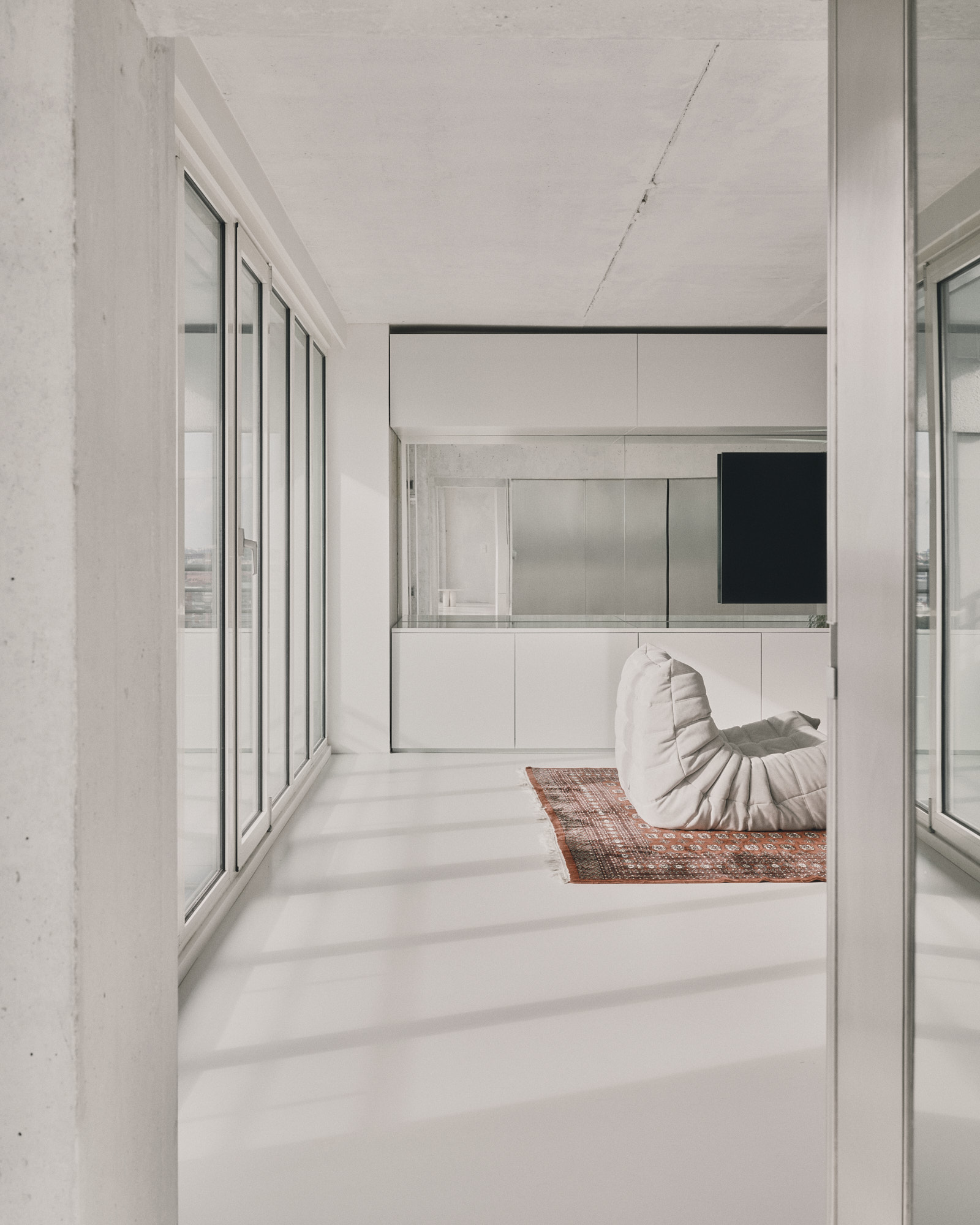
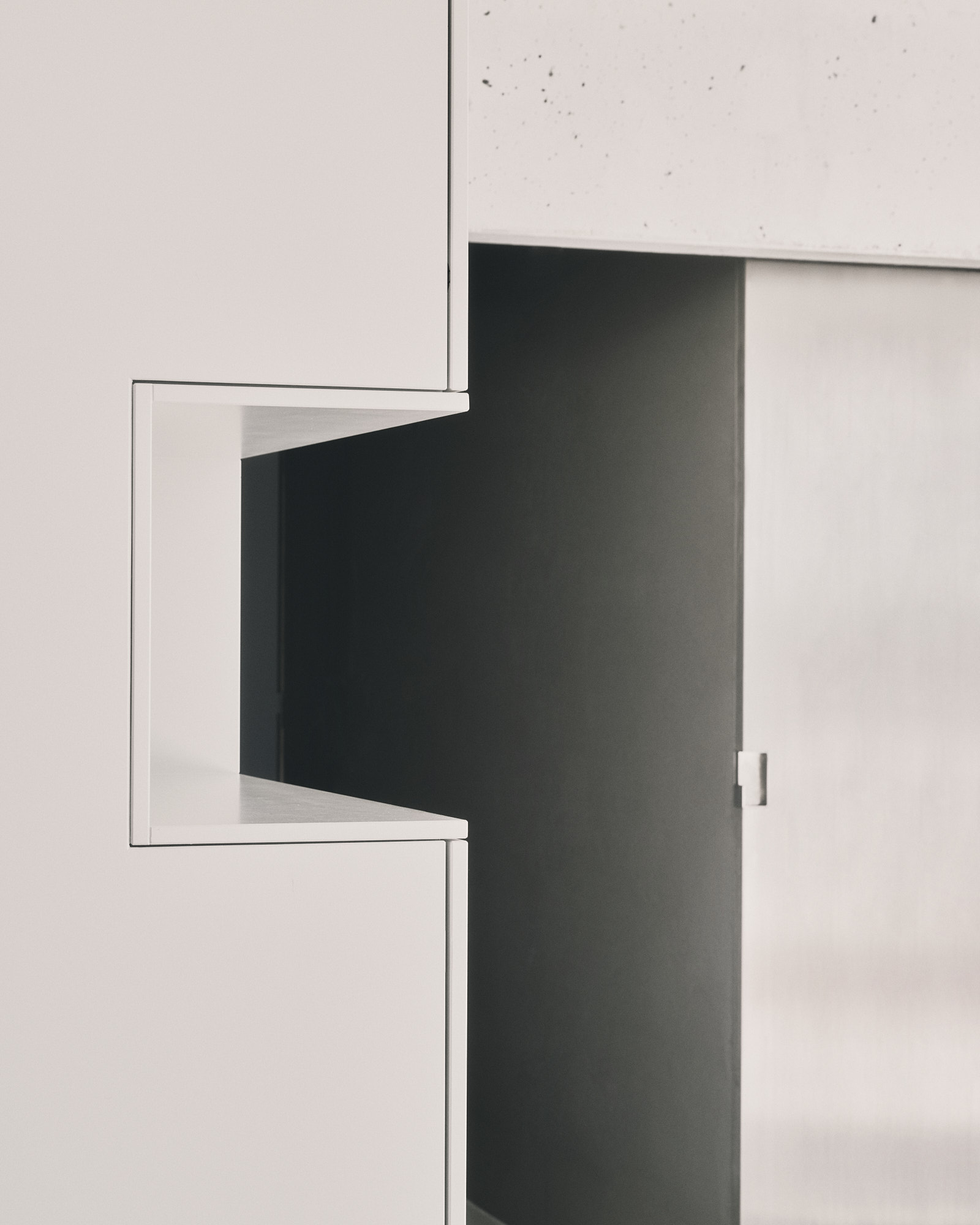
Around the exposed structure, the renovation adds precision: white millwork running floor-to-ceiling along the corridor and main rooms, flush-panel storage aligned with white resin floors and white-painted walls, custom joinery that routes around columns rather than concealing them. The concrete and the cabinetry are in direct relation: one industrial and fifty years old, the other precision-made and new.
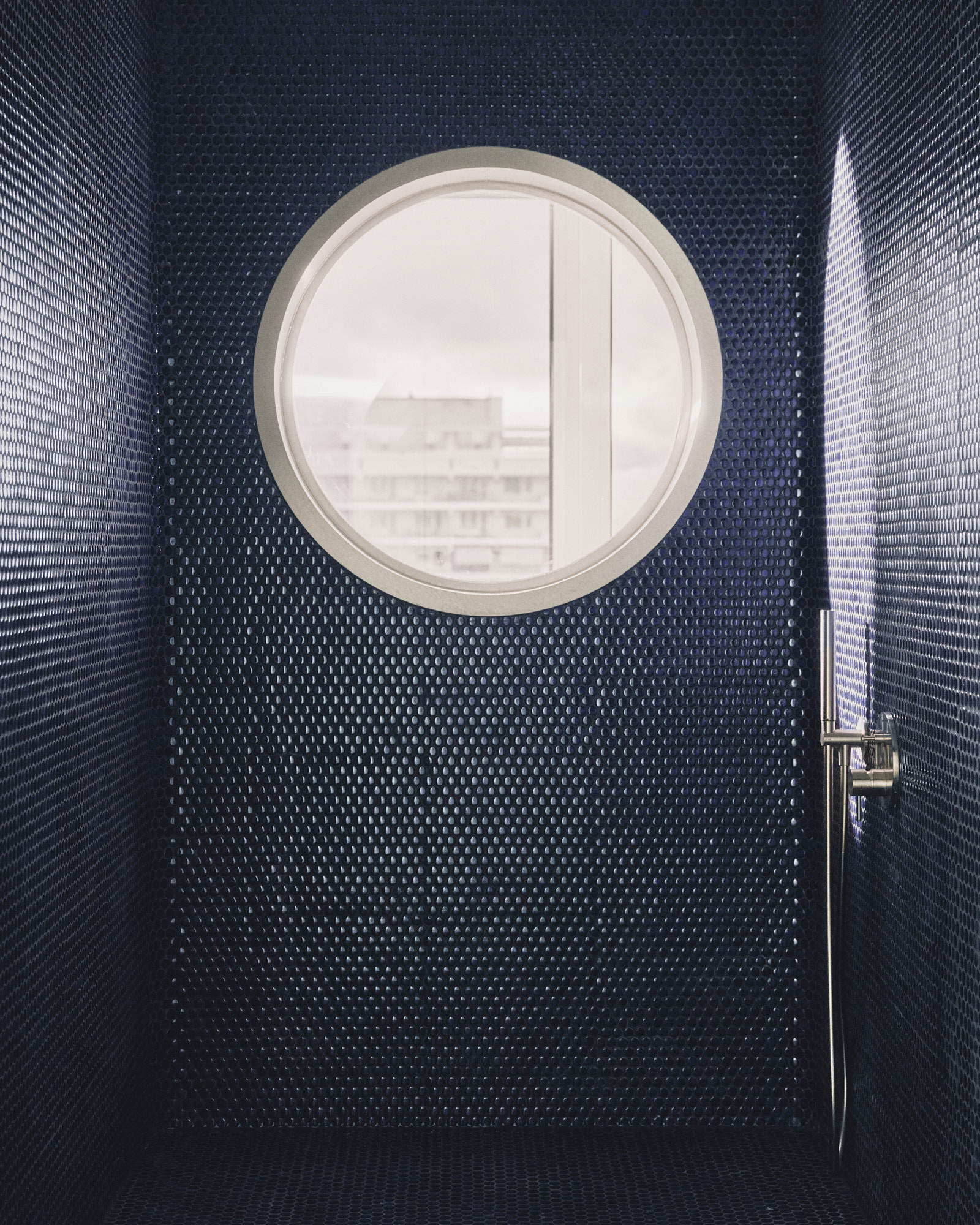
The bathroom inverts this logic. Where the rest of the flat is white, open, and oriented toward the city, the bathroom is enclosed: dark navy mosaic tile, floor to ceiling, corner to corner. A single round porthole window, the only circular aperture in the flat, is punched through the exterior wall at eye level, framing a direct view of the building across Leipziger Straße. It is the one room that does not return the city to the occupant.
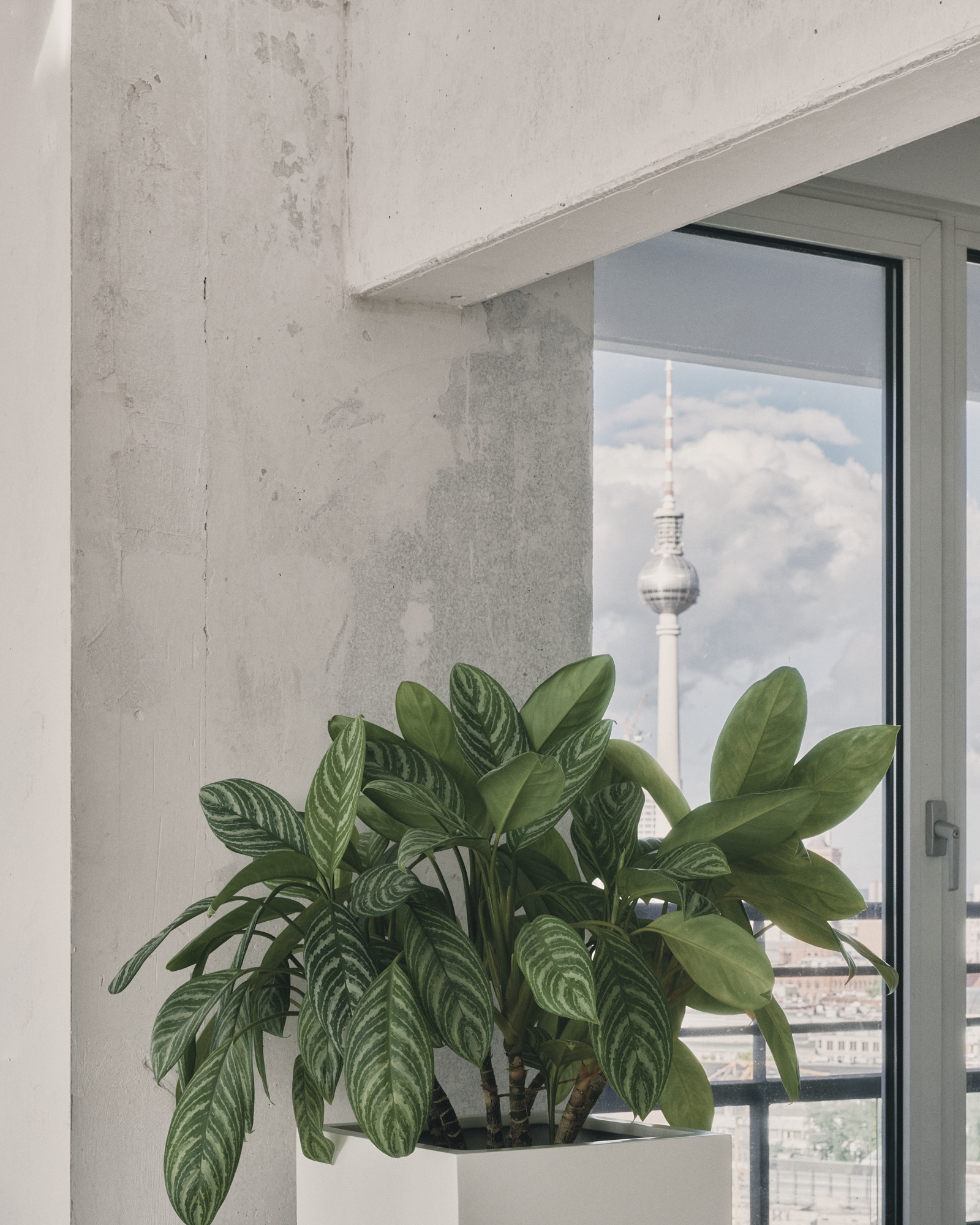
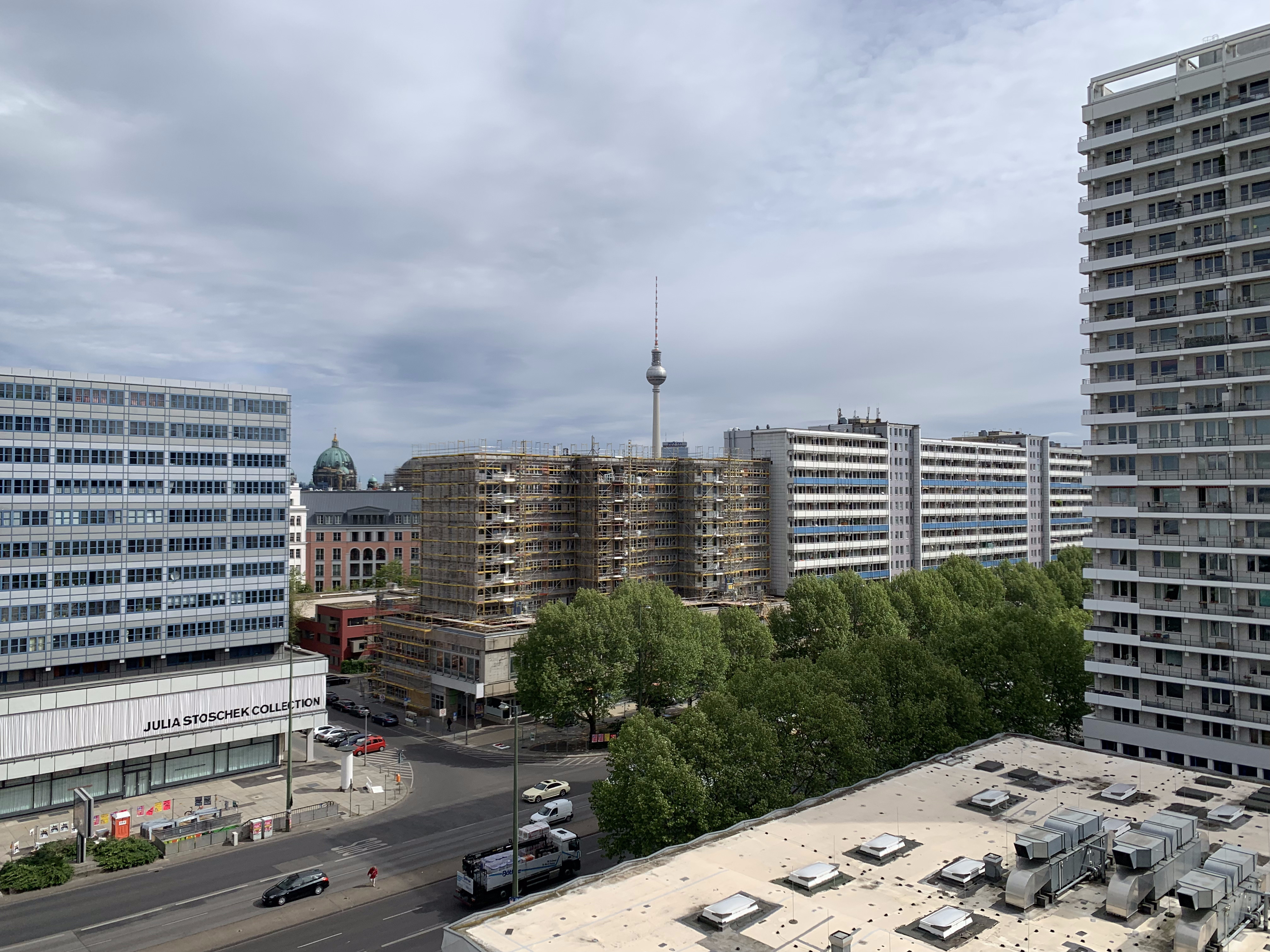
From the 20th floor, the building's original context is legible. The Fernsehturm is at eye level to the east. The Gendarmenmarkt and Potsdamer Platz are visible to the west. The complex, built as part of the DDR's representation of its own urban capacity, functions from here as a vantage point onto the other constructions the DDR was simultaneously making claims about. The competing architectural statements of several decades are visible in a single frame.
The renovation does not resolve this condition. The exposed concrete records the building's origins. The white resin floor and millwork mark a present that is deliberate without being ideological. The porthole bathroom looks directly at the building across the street. From the western balcony, the city extends in every direction without a resolved interpretation on offer.
— Floor plan
— V
On what a space carries and what it cannot
A building does not know its own history. The panels on Leipziger Straße carry no record of who lived inside them or under what conditions, no trace of the Stasi file or the diplomatic assignment or the years on the waiting list. The building holds load. Everything else was held by the people, and the people have moved on.
What is already in a space, when a renovation begins, is not raw material. It is information: material layers, structural logic, light conditions, the spatial residue of previous use. Both of these projects took that information as the starting point rather than an obstacle. The question was not what the flat should ideally become but what the existing conditions permitted and suggested.
Renovating inside the WBS 70 system is a negotiation with industrial standardisation. The exterior walls cannot move. The floor-to-ceiling height and window positions are fixed by the panel grid. Within those constraints, within a geometry designed for replicability rather than particularity, the work becomes a question of what particularity is possible. Sixty years of occupation will differentiate any standardised unit from its neighbours. The evidence of that differentiation is what both projects found when they began.
The towers on Leipziger Straße were built as a statement about urban organisation under a specific set of political beliefs. Those beliefs have passed. The towers remain. They have outlasted the ideology that produced them, the wall that gave the address its symbolic charge, the postage stamp that commemorated them, and the files that recorded their occupants. They will outlast these renovations as well. The concrete stands in the middle of a city that continues to make decisions about what to do with what it has inherited.